
Streamline Your Inbox: How AI Automation for SMEs Can Transform Customer Enquiries
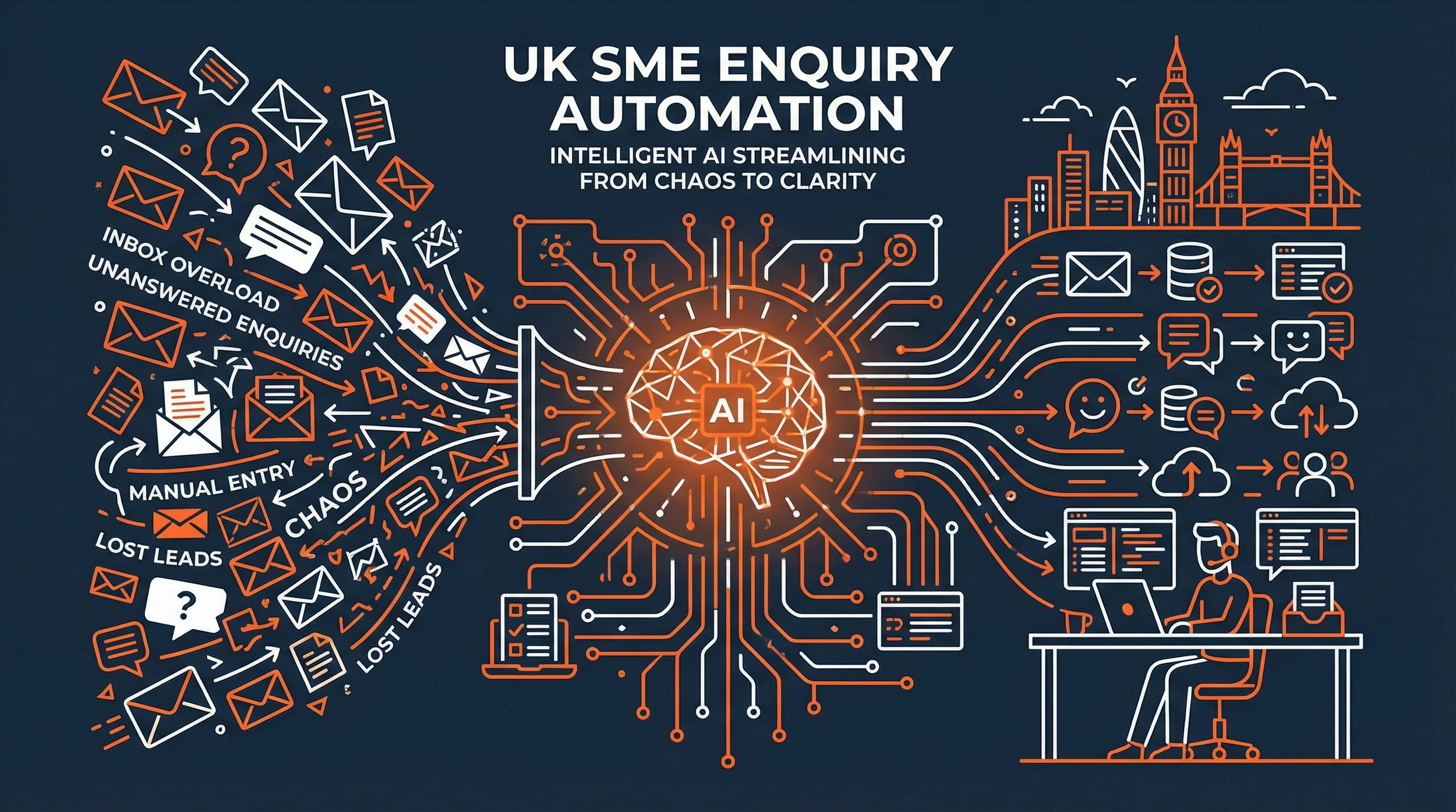
Picture this: it's Monday morning, and your inbox is overflowing. Customer enquiries, support requests, and sales leads are all piling up, each demanding a personal touch. Your team is working flat out, yet the backlog grows. Sound familiar?
For many UK SMEs, manual customer enquiry handling isn't just a time sink; it’s a drain on resources and a bottleneck to growth. But what if you could equip your team with an intelligent assistant that handles the routine, drafts responses, and ensures no query ever falls through the cracks? This isn't science fiction; it’s the power of AI automation, and it’s accessible for businesses just like yours.
The Power of AI Automation for SMEs: Beyond Basic Replies
Gone are the days when automation simply meant auto-responders. Today, integrating Large Language Models (LLMs) like ChatGPT, Gemini, or Claude with robust workflow automation platforms (such as Zapier or Make.com) creates a sophisticated system that can genuinely understand, process, and act on incoming communications.
Scenario 1: Intelligent Enquiry Triage and Response Drafting
Let's consider a bustling online retailer receiving hundreds of customer service emails daily. Manually reading, categorising, and responding to each one is a huge undertaking.
The Manual Grind: A team member opens an email, reads it, determines if it's a refund request, product query, or delivery issue, then manually drafts a response or forwards it internally. This process is slow, prone to inconsistency, and costly.
The AI Automation Solution:
Trigger: A new email arrives in your customer service inbox (e.g., via Outlook or Gmail).
Action (Workflow Automation): A platform like Make.com or Zapier detects the new email.
Action (AI Processing): The email content is automatically sent to an LLM (e.g., ChatGPT-4). The LLM analyses the text to identify the customer's intent (e.g., "delivery update," "product fault," "account query") and extracts key information like order numbers or product names.
Action (AI Drafting): Based on the identified intent and extracted data, the LLM drafts a personalised, context-aware response, drawing from your pre-approved knowledge base or FAQs. For example, if it's a delivery query, it might suggest checking the tracking link and provide a link to your shipping policy.
Action (Workflow Automation): The drafted response is then sent back to your team for a quick review and one-click approval, or routed directly to the customer for certain low-risk queries. Simultaneously, the automation can update your CRM (e.g., Salesforce, HubSpot) with a summary of the interaction and the customer's query type, creating a structured record.
The benefit? Responses are significantly faster, customer satisfaction improves, and your team is freed from the drudgery of repetitive tasks, allowing them to focus on complex cases that truly require human empathy and problem-solving.
Scenario 2: Automating Post-Enquiry Follow-Ups and Internal Notifications
After an initial query is handled, there's often follow-up work or internal communication required.
The Manual Grind: After responding to a customer, an team member might manually copy details into a spreadsheet, notify a colleague in Slack about a high-priority issue, or remember to schedule a follow-up task in a project management tool.
The AI Automation Solution:
Trigger: An AI-drafted customer response is approved and sent, or a specific keyword is detected in a conversation summary.
Action (Workflow Automation): The automation platform automatically updates the customer's record in your CRM with the interaction details and status.
Action (Internal Notification): If the LLM flagged the query as "high priority" or a specific product issue, the automation can instantly send a notification to the relevant team channel in Slack or Microsoft Teams, complete with a summary of the issue and a link to the CRM record.
Action (Task Creation): For complex issues requiring further investigation, the system can automatically create a task in your project management software (e.g., Trello, Asana) assigned to the appropriate team member, ensuring nothing is overlooked.
This ensures seamless internal communication and follow-through, drastically reducing the chances of missed tasks and improving overall operational efficiency.
The SmartOps Perspective: Building Robust AI Automation for Your Business
The tools for AI automation are powerful, but integrating them correctly to build reliable, business-critical workflows requires expert architecture. Setting up a simple trigger-action sequence is one thing; designing a system that accurately interprets nuanced customer language, integrates flawlessly with your existing tech stack, and operates reliably 24/7 is quite another.
At Perkins SmartOps, we are your builders and guardians. We don't just recommend tools; we design and implement custom workflows tailored to your specific needs. From integrating your communication channels (email, chat, social media) with LLMs, to connecting them seamlessly with your CRM, accounting software (like Xero), and internal communication platforms, we handle the complexity.
Crucially, we provide ongoing monitoring and maintenance. This ensures your AI doesn't fail silently or "hallucinate" unchecked, offering Tier 1 Support to keep your automated systems running smoothly and effectively, delivering consistent, measurable outcomes for your business.
Key Takeaways for UK SMEs:
Reduced Manual Labour: Free your team from repetitive tasks, saving valuable hours (and pounds!) each week.
Faster Turnaround Times: Respond to customer enquiries almost instantly, boosting satisfaction and loyalty.
Consistent Service: Ensure every customer receives accurate, on-brand information, every time.
Enhanced Data Accuracy: Automatically log interactions and key data in your CRM, reducing human error.
Ready to streamline your operations and transform your customer enquiry process? Talk to Perkins SmartOps about building your custom AI automation today.
